
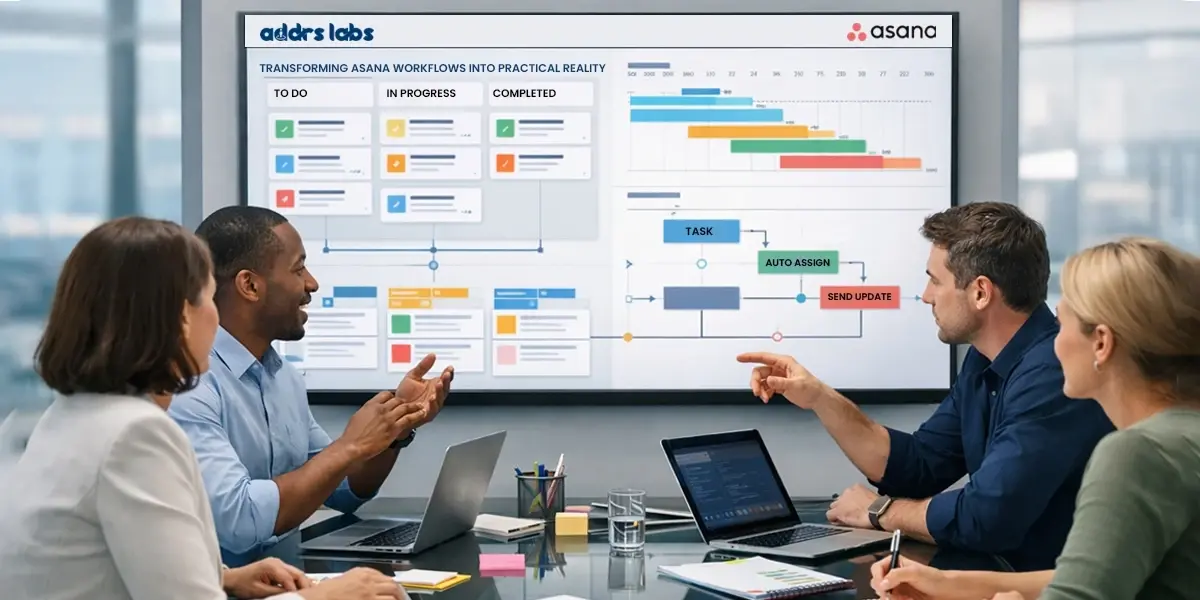
Are you really able to manage projects without chasing updates every day? Do your teams know exactly where work stands, or does tracking progress still feel like guesswork? And while collaboration tools promise clarity, does collaboration actually happen smoothly across teams? These are not big questions. Instead, they are small frustrations that accumulate and eventually slow the work of the teams. Most organisations nowadays are not lacking in tools, but they lack a clear structure, adoption, and workflows that truly reflect people's work.
There is no doubt that Asana is a powerful tool. However, being powerful alone does not promise results. The real change happens when Asana is designed, configured, and implemented in such a way that it fits your processes and does not require teams to change immediately. This is why professional Asana implementation can get away from being just about features and focus more on the practical aspects. Let's see how well thought-out workflows can help teams be more productive, communicate clearly, and confirm using Asana as their tool of choice every single day.
What Ensures Success in Asana?
Most teams approach an Asana journey with the best of intentions. They set up tasks, including projects, and insert deadlines. For several weeks, they have been organized. Then, over time, they begin to notice that issues exist. Tasks become overdue without any sense of the flow. Ownership becomes unclear, and teams go back to chats, emails, and follow-ups.
Sound Familiar? This happens because, like all powerful applications, Asana first needs structure before speed. Without a proper design with regard to "workflow," it's just another task list. The tool still works, but the use remains inefficient. The question then becomes simple. How do you actually start using Asana and, in turn, work through Asana?
Workflows That Match Real Business
Every organization works differently. The creative team does not work like the finance team, and a marketing campaign does not move to the same beat as internal operations. Yet, so many implementations seek to standardize everything.
Effective design of an Asana workflow avoids this trap. Instead, workflows center on:
- Clear stages of work
- Defined ownership at every step
- Simple handoffs amongst teams
- Visibility without micromanagement
When the workflows reflect reality, then the adoption becomes natural. Teams would not need to be reminded to use the system. It becomes the easiest place to work. And yes, that is where professional tuning makes all the difference.
Read More: Software Process Workflows in Software Project Management (SPM)
How it Enhances Tracking Visibility
Meetings to simply ask "Where are we?" should not be necessary for tracking progress. Visibility is Asana's strong suit, but only with careful configuration.
When workflows consist of:
- Explicit task ownership
- Reasonable deadlines
- Truly important dependencies
- Easy-to-maintain status updates
Without effort, progress becomes apparent. Leaders have a broad perspective, teams see what to do next, and everyone is aware of what is blocked and why.
How it Promotes Collaborative Teamwork
In many teams, collaboration still means long message threads and scattered feedback. Asana changes this discussion as files and decisions stay attached to the work itself. The work stays in one place, conversations become relevant, and new team members catch up without confusion. And honestly, who does not want fewer emails?
When configured correctly, teams can:
- Comment directly on tasks
- Share files without losing context
- Track decisions transparently
- Reduce dependency on emails
How to Implement for the Best Results?
Even the best-designed system fails if teams do not implement it. Adoption is not about training sessions, but rather about confidence. People need to understand why the system exists and how it helps them personally.
This is why structured rollout and enablement matter.
Good Asana professionals focus on:
- Role-based onboarding
- Gradual rollout instead of a sudden change
- Practical examples, not generic demos
- Continuous support during early usage
Over time, the system becomes familiar, resistance drops, and usage increases naturally. This is where AddrsLabs focuses strongly, ensuring teams are not just introduced to Asana but actually supported as they begin using it daily.
Read More: How Precise is Here Technology and how can we benefit from it?
Skills That Truly Matter in an Asana Partner
Choosing the right professionals is not about certifications, but rather about experience, judgment, and the ability to simplify complexity.
Here are the skills that separate configuration from transformation.
Together, these skills ensure Asana becomes a working system, not just a vanity project.
Avoiding Common Asana Implementation Mistakes
Have you seen teams abandon tools quietly rather than complain openly? That usually signals poor fit, not poor intention. Many organisations struggle not because Asana lacks capability, but because of avoidable mistakes.
Some common ones include:
- Building workflows without user input
- Over-automating too early
- Ignoring reporting and visibility needs
- Skipping post-launch optimisation
- Treating Asana as a one-time setup
Why Professional Asana Implementation Pays Off
Could teams set up Asana themselves? Yes. But will it deliver consistent, long-term value without guidance? Rarely. While Asana is intuitive on the surface, its real power lies in how well it is structured around your workflows, decision points, and team behaviour. Without a clear implementation strategy, teams often end up with cluttered projects, duplicated tasks, inconsistent usage, and declining engagement over time.
Professional implementation eliminates these issues early. It saves weeks of trial and error, reduces rework caused by poorly designed workflows, and significantly improves adoption across teams. Most importantly, it safeguards the investment you have already made in the platform by ensuring Asana is used as a system of record, not just another task list.
Final Thoughts
Managing projects, tracking progress, and collaborating effectively should not feel like extra work. With the right design and professional guidance, Asana can simplify complexity instead of adding to it. Addrs Labs supports organisations by designing and configuring Asana in a way that aligns technology with people, not the other way around. Workflows are designed to align with how teams actually operate, making collaboration intuitive, accountability clear, and progress visible.
The result is an Asana environment that teams trust, adopt naturally, and continue to use effectively as the organisation scales. By focusing on real workflows, team adoption, and long-term usability, Addrs Labs helps organisations turn Asana into a practical, dependable system that teams actually use. Ultimately, it is not tools that create impact, but rather well-designed workflows.



Comments (0)
No comments posted yet. Be the first to comment!