
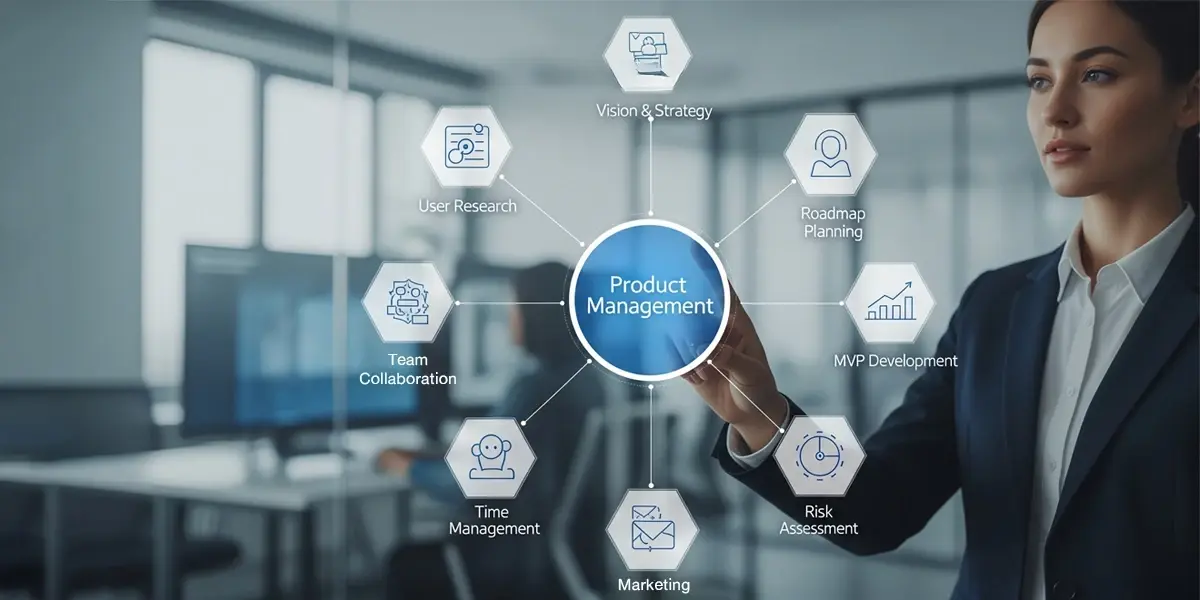
Great ideas and products are everywhere, but successful products? They are rare, and this is why the difference between the two usually isn’t luck or funding, it’s product management !
If you have ever wondered why some products just click with users, whereas others quietly disappear, you are about to find out why. Product management fundamentals primarily act as the invisible thread that ties customer needs, business goals, and technology into one seamless story, and today, we are going to walk you through the basics by highlighting practical insights that actually make sense.
What Does a Product Manager Really Do?
Imagine you are building a house, designers draw it, engineers construct it, marketers sell it, but someone has to decide what kind of house it should be in the first place. Like, how many rooms the house has, for whom it is and at what cost? That’s the product manager.
A product manager is the voice of the customer, the translator between teams, and the decision-maker who ensures that the product solves the right problem, not just any problem. They don’t just ask, “Can we build this?” They rather ask, “Should we build this?”
Read Also: The Blueprint vs. The Toolbox: How to Master Both PCM and PMS
Fundamental #1: Start with the Problem, Not the Product
This is where many teams stumble because they fall in love with features before understanding the pain point. However, strong product management flips that approach because instead of saying “Let’s build an app with 10 features,” a good PM asks:
- What’s frustrating users today?
- Why are they losing time or money?
- What are they currently forced to compromise on?
When you clearly define the problem, then the solution almost starts designing itself, and the best part is you avoid building features that no one asked for, and instead focus on the features that are in demand.
Fundamental #2: Know Your Users Like You Know Your Friends
You wouldn’t buy a gift for a friend without knowing what they like, right? The same applies to products. Successful product development is rooted in:
- User interviews
- Feedback loops
- Behavioral analysis
- Constant curiosity
Users don’t always tell you what they want, but they always show you what they need, and efficient product management focuses on listening between the lines. In fact, a study by McKinsey & Company shows that organizations focusing on customer-centric strategies have a 60% higher likelihood of achieving profitability. (Source)
Read Also: How to Build a Product Roadmap with Asana: A Step-by-Step Guide for 2025
Fundamental #3: Aligning Vision with Business Goals
A product can be loved by users and still fail if it doesn’t support the business. That’s why product management lives at the intersection of user value and business value. A clear product vision answers three questions:
- Who is this product for?
- What problem does it solve?
- Why does it matter to the business?
When this vision is clear, decision-making becomes easier, roadmaps make sense, teams move faster, and priorities stop feeling cluttered.
Fundamental #4: Prioritize the Right Way
You will always have more ideas than time- ALWAYS! This is where strong product management should emphasize prioritizing what not to build, instead focusing on what to build. Here’s a simple way efficient product managers think about priorities:
| Priority Factor | What It Answers |
| User Impact | Does this solve a real user problem? |
| Business Value | Will this move key metrics? |
| Effort | How complex or costly is it to build? |
| Timing | Is this the right moment |
Balancing these factors can help teams to focus on what truly matters instead of chasing shiny distractions.
Fundamental #5: Collaboration Over Control
Contrary to popular belief, product managers don’t “own” the team. They enable the team. Product development is a team sport between designers, developers, QA, marketing, sales- all bringing different perspectives. The PM’s role is to create clarity, remove confusion, and keep everyone moving in the same direction. When collaboration works, magic happens. When it doesn’t, even the best ideas struggle to survive.
Fundamental #6: Build, Learn, and Adapt Fast
No product is perfect at launch. And that’s okay. The goal isn’t perfection, it’s progress. Great product management embraces experimentation with aspects like:
- Launching early versions
- Measuring real usage
- Learning from feedback
- Improving continuously
Read Also: Strategic vs Tactical Planning: What’s the Difference?
Final Thoughts, and Your Next Smart Move!
Robust product management doesn’t end with a great idea or even a well-built product; it succeeds when teams are aligned, workflows are clear, and execution feels effortless, not chaotic. That’s where the right systems, processes in work and the right partners make all the difference.
Also, if your product teams are juggling priorities, struggling with visibility, or feeling slowed down by inefficient processes, Addrs Labs can help you turn that complexity into clarity. As a digital transformation firm and Gold Asana Partner, Addrs Labs specializes in workflow automation, work management, and location intelligence, which bridges the gap between strategy and execution so your products don’t just launch, but scale successfully.
Whether you are streamlining product roadmaps, aligning cross-functional teams, or building a smarter way to work with tools like Asana, Addrs Labs helps you unlock peak performance with systems designed for real-world growth. Because great products deserve equally great execution, and that’s where successful product development truly comes to life.




Comments (0)
No comments posted yet. Be the first to comment!