
Managing projects effectively and submitting within the deadline in a dynamic environment demands structured approaches, yet many teams struggle with misalignment between strategy and execution. Despite having access to advanced project management software , many organizations continue to face delays, scope creep, and execution inefficiencies.
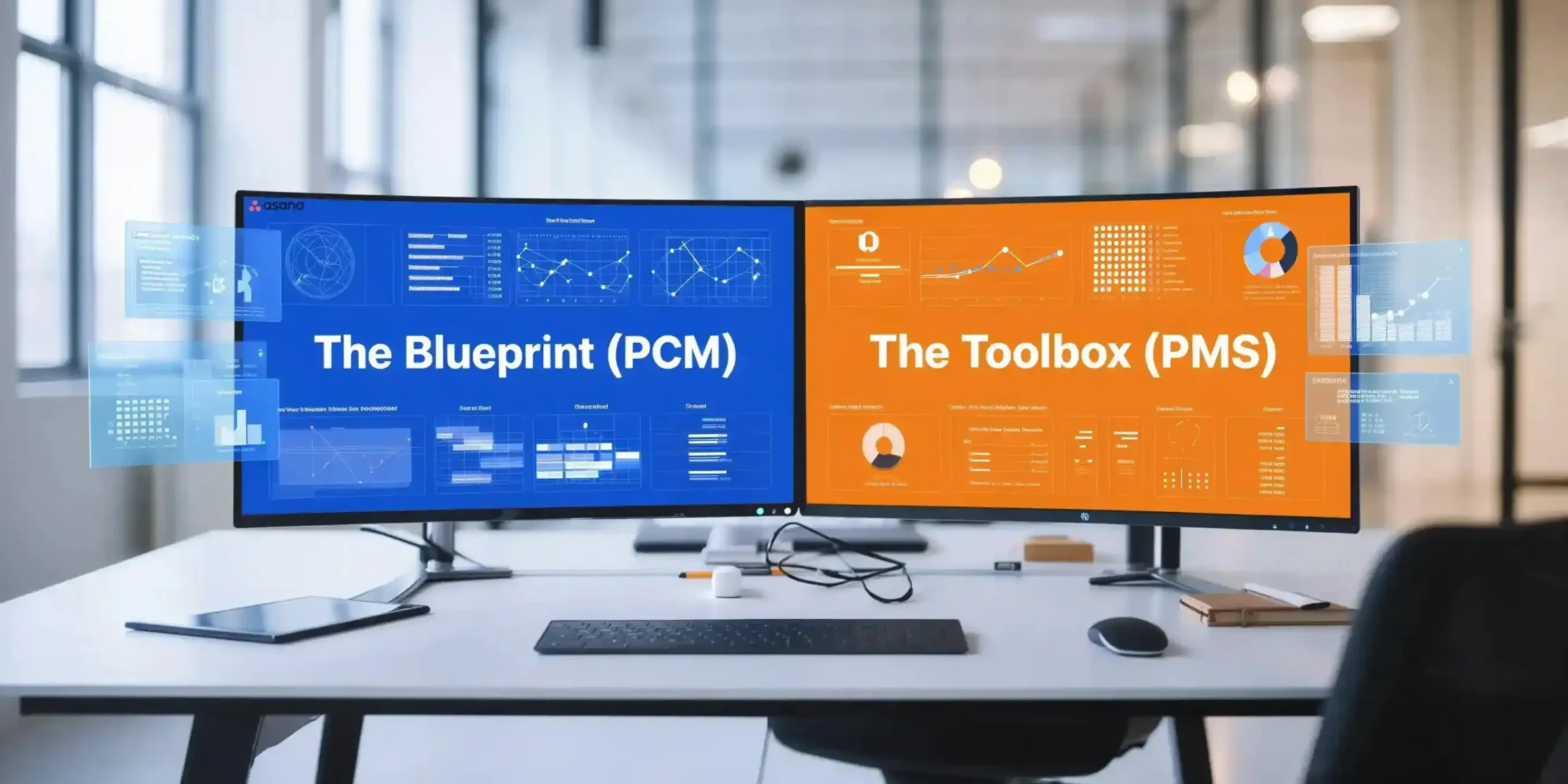
The main cause is often not the absence of tools, but the absence of a structured project cycle management framework that governs how projects are conceived, planned, executed, and also how it is being monitored. Basically, project success is driven by two distinct yet interdependent components namely: framework and a tactical execution system. PCM functions as the strategic blueprint while PMS serves as the operational toolbox which ensures precise delivery, risk mitigation and measurable outcomes as well. That is why the integration transforms abstract plans into actionable and measurable results.
What is Project Cycle Management?
Project cycle management defines the structured sequence of phases that govern a project’s lifecycle, ensuring systematic progression and evaluation. Unlike software platforms that focus on task execution, project cycle management establishes governance, decision making checkpoints, and outcome oriented planning across each project phase.
PCM typically consists of the following stages:
- Project Identification: The definition of the business problem, objectives, and strategic relevance.
- Project Design and Planning: Definition of scope, feasibility analysis, risk assessment, and resource planning.
- Execution and Monitoring: Manage implementation, keeping track of performance against predefined indicators.
- Evaluation and Closure: Evaluate outcomes, capture lessons learnt, and ensure strategic alignment.
By enforcing a disciplined lifecycle approach, project cycle management secures both the efficient execution of projects and their alignment with organizational priorities for the creation of long-term value.
Read Also: What Is Workflow Management?
PCM as the Strategic Blueprint
Project Cycle Management serves as the high level blueprint outlining the project’s strategic pathway. Well, it establishes clarity before execution and ensures that every operational activity supports a defined objective. Therefore, without this blueprint, teams may remain operationally busy hence failing to deliver measurable business outcomes.
Key strategic functions are-
- Defining the success criteria and performance indicators
- Establishing governance structures and approval gates
- Aligning project outputs with organizational strategy .
- Identifying risks and mitigation strategies early in the lifecycle.
Most importantly, PCM answers the critical questions of what should be built, why it matters, and how success will be measured.
PMS as a Tactical Toolbox
On one hand it has been seen that PCM defines the structure, whereas on the other hand Project Management System (PMS) enables execution. PMS platforms provide operational capabilities required to implement plans, coordinate teams, and monitor progress in real time. Tools like Microsoft Project, Jira or Asana provide functionalities such as-
- Assigning of Task and dependency mapping.
- Real-time dashboards for status updates.
- Resource allocation and time tracking
- Automated alerts for deviations.
Therefore, PMS operationalizes project cycle management by digitizing workflows, reducing manual errors, and providing granular visibility.
Read Also: How Can Organizations Benefit From a Project Management Platform?
PCM versus PMS: A Formal Perspective on Functional Distinctions
The basic distinction between PCM and PMS is not one of competition but of complementarity. Their respective roles can be clearly differentiated as follows:
- Project Cycle Management: strategic planning , lifecycle governance, outcome alignment.
- Project Management System: Task execution, progress tracking, and operational coordination.
So, in general, PCM basically determines what needs to be done and why, while PMS determines how things are done and when they get done.
Rationale for Mastering PCM and PMS
It is a known fact that an effective project delivery must combine strategic intent with tactical execution. PCM without PMS produces well-thought-out plans that fall flat in implementation; PMS without PCM is an effective activity with little strategic outcome.
Accordingly, leveraging project cycle management with a competent PMS can help organizations achieve to:
- End-to-end visibility across the project lifecycle.
- Coherent decisions through predefined governance checkpoints.
- This will ensure greater accountability through well-defined responsibilities and milestones.
- Predictable delivery supported by real-time execution.
Implementation of PCM and PMS in a Unified Framework
So, in order to operationalize both components effectively, organizations must adopt a structured integration approach:
- Establish lifecycle governance
Define project phases, approval gates, and success metrics, using a project cycle management framework before configuration of any tool.
- Configure PMS Around PCM Stages
Secondly, align task boards, workflows, and reporting structures within the PMS to mirror PCM lifestyle stages rather than generic task lists.
- Enable performance monitoring
PMS dashboards should be used to monitor progress against PCM-defined indicators on scope observance, risk exposure, and completion of milestones.
- To conduct continuous evaluation
Use post-project evaluations to revise planning assumptions and improve the management of future project cycles.
Read Also: AI-Driven Workflow Management: The Future of Business Automation
Why Integration of PCM and PMS Forms the Foundation for Project Success
Trusting on project cycle management in isolation can result in strong plans with weak execution, but at the same time, relying on a PMS alone often produces activity at the level of tasks without strategic direction. Putting both together means that there is coherence between planning and execution along the whole lifecycle of the project.
Enhanced Visibility
When there is direct linkage between project cycle management phases and PMS dashboards, the team sees everything from planning to delivery. Progress can be tracked against approved baselines, enabling teams to detect schedule deviations early and take corrective action before issues escalate.
Risk Mitigation
PMS tools automatically monitor the project cycle management framework for timely completion and budgets, using AI analytics to flag risks.
Resource Optimization
By connecting PMS information to project cycle management reviews, leaders make appropriate resource allocations based on hard data and avoid overloading teams, smooth workload peaks, and ensure attention to critical activities in each project phase.
Stakeholder Alignment
Real-time PMS reports support project cycle management gates by helping to make informed decisions and ensuring transparency in communication.
Conclusion:
Tools alone cannot guarantee success in modern project environments. To effect sustainable delivery, there is a need for a structured approach-a merger of planning discipline and execution capability. The blueprint provides the direction, while execution comes from the toolbox, culminating in predictable success.
Thus, mastery in both PCM and PMS empowers the organization to transition project delivery from a set of fragmented activities into a coherent, outcome-focused system that guarantees clarity, control, and-most importantly-predictable success along the entire cycle of the project.


Comments (1)
randx-super.ru
August 02, 2026 at 08:11 am
Безопасное увлечение ставками — это практика, ориентированный на обеспечение баланса над своими решениями и признание опасностей, связанных с игровой деятельностью, при одновременном акценте на отдых как основную цель участия.
https://randx-super.ru/